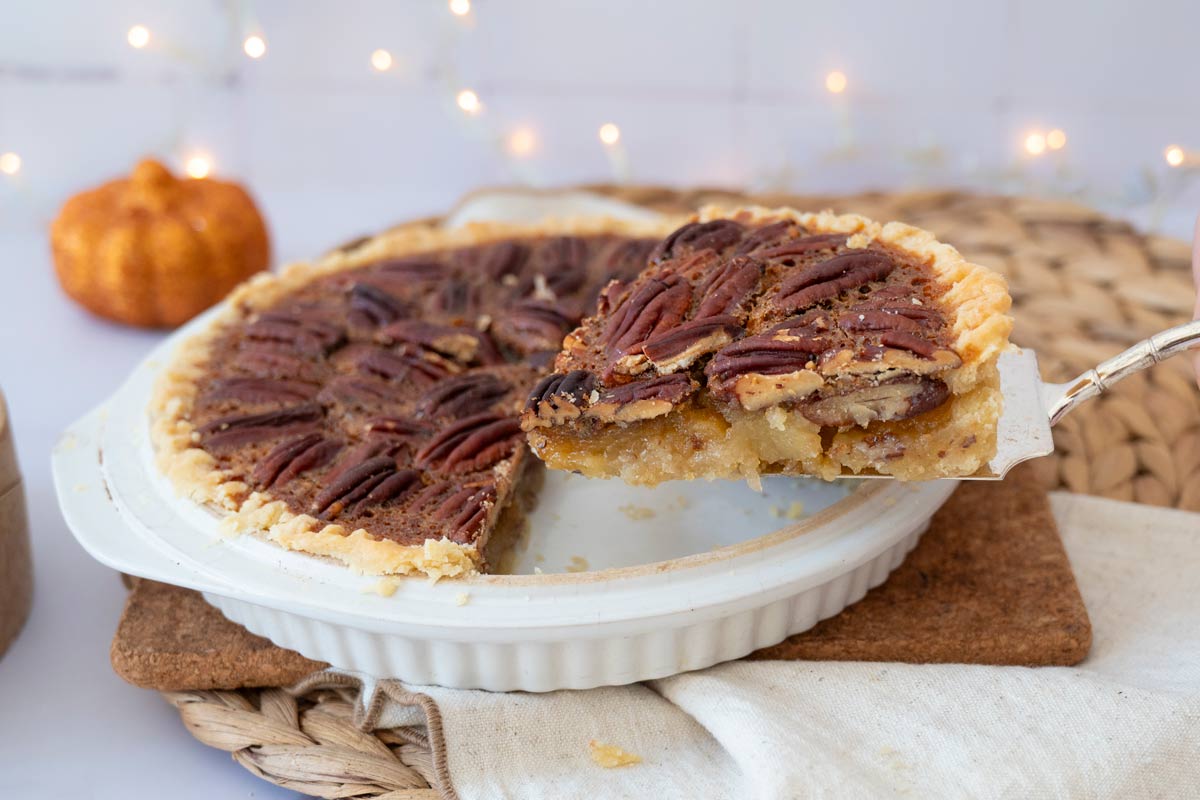
Thanksgiving Eve. The crust’s in the fridge, the oven’s preheating, and the Karo bottle has maybe two tablespoons sloshing around the bottom. (Or you’ve sworn off the stuff and the recipe never got the memo.) Either way, the recipe card isn’t much help.
Some substitutes work almost invisibly. Others change how a pie sets or how fast a caramel burns, and it’s better to know that before the oven’s on. Here’s what each common swap does, explained by what corn syrup was doing in the recipe to begin with.
What Corn Syrup Does in a Recipe
Sweetness is the smallest part of its job. Flip a bottle of Karo Light and check the label – 30g of carbs per 2 tablespoons, yet only 10g count as sugars. What’s the other 20g? Longer glucose chains. They make the syrup thick and don’t do much for sweetness.
Those chains are the real reason it’s in your pecan pie. They wedge themselves between sugar molecules so those can’t stack into crystals, and that’s what keeps a pie filling glossy and a caramel smooth rather than sandy. It also hangs onto water, so pecan bars still bend instead of snapping on day three.
Quick side note, since people mix these up constantly – regular corn syrup and high-fructose corn syrup aren’t the same thing. Karo Light and Dark both contain none – HFCS is a separate, further-processed product.
Tapioca Syrup: The Closest Swap
If you’re comparing tapioca syrup vs corn syrup for baking, the two are closer than the marketing suggests. Each one is a glucose syrup made by chopping up starch (cassava for one, corn for the other), which means each blocks crystals in pretty much the same way. Go 1:1, and your pie won’t know the difference.
Where they split is shopping and taste. Organic, non-GMO tapioca syrup is easy to track down, and it has almost no flavor of its own – exactly what candy companies like about it. Austin’s Hometown Hero, a gummy maker, dropped corn syrup for tapioca to get cleaner fruit flavor and a softer chew. Health-wise? Sugar is sugar, and a spoonful of either is still a spoonful, front-of-label promises aside.
Look for bottles labeled tapioca syrup or cassava syrup in the baking aisle at natural grocers. A few brands pour like cold molasses, so stand the bottle in a mug of hot tap water for a minute before measuring.
Swapping in Golden Syrup or Maple
Lyle’s Golden Syrup is the next-best swap. British bakers reach for it the way Americans reach for Karo. It’s cane sugar partly broken down into glucose and fructose during processing, and that mix blocks crystals about as well as corn syrup does. Use the same amount and you get a slightly butterscotch-y pie – nobody at my table has complained yet.
Maple’s a different story. It’s mostly plain sucrose and noticeably thinner, so the filling sets softer. I found that out cutting into a maple pecan pie while it was still warm – the middle just slumped onto the plate. Give it three or four hours on the counter. And buy the dark, robust grade, because amber maple gets lost under all those pecans.
Candy Is Where Swaps Go Wrong
Candy is where substitutes cause trouble. Honey is loaded with free fructose, and fructose starts browning at a far lower temperature than table sugar. Follow a corn syrup recipe’s timing with honey and the caramel can go from amber to bitter while you’re still reaching for the cream. Trust a candy thermometer and your eyes, not the timer.
No syrup at all? A pinch of cream of tartar or a squeeze of lemon juice in the sugar and water does a rough version of the same job. The acid splits some of the sucrose as it boils, and those split sugars interfere with crystals much like corn syrup would. It’s less reliable, but it works for one batch of caramel sauce.
Skip brown rice syrup for candy. A 2012 Dartmouth study found arsenic in organic products sweetened with it, including some cereal bars and toddler formula. A single batch is a small exposure, but tapioca syrup does the same job without the question.
Glazes for Ham and Ribs
Glazes are forgiving. Any of these syrups gives you shine and helps the glaze cling, and nobody will be checking for crystals on a ham.
Burning is the real concern. Honey and maple both scorch sooner than corn or tapioca syrup, so on ribs or a spiral ham, save them for the last 10 to 15 minutes of cooking. Corn and tapioca syrup can handle a longer stretch in the oven before they char.
* * *
Corn syrup is mostly there to block crystals and only a little to sweeten – keep that in mind and the choice gets easy. A glucose syrup like tapioca can stand in anywhere. Honey and maple work too, they just shift the flavor and the timing. That’s plenty for a two-person pie or a single jar of caramel sauce, no last-minute grocery run on Thanksgiving Eve required.
Laura is a home cook, with 25 years experience behind the stove, who spends an extraordinary amount of time in the kitchen cooking. She loves making new recipes and finding wonderful new things to eat, both at home or abroad. She spends a lot of time researching, crafting, and perfecting her recipes.